Case Study

Salterra Enterprises

From experienced operator to market-ready consulting brand. A ground-up build — positioning, website, service architecture, and practical launch support.

Brand PositioningWebsite BuildService ArchitectureCTA FlowLaunch Support

Salterra Enterprises is the independent consulting brand of a senior financial services operations leader with decades of enterprise-level experience spanning banking, insurance, and financial operations management.

The client had spent a career building and running complex operational systems inside large organizations. The knowledge was real, the track record was proven — but none of it existed in a form that an independent market could see, evaluate, or hire.

Client TypeSenior financial services operations leader launching independently
IndustryFinancial services operations / consulting
ScopeBrand positioning, website design and build, service architecture, launch strategy
OutcomeMarket-ready consulting brand — launched
The core problem

Experienced operators who go independent often discover that institutional credibility doesn't automatically translate into market credibility. The skills are real. The positioning is invisible. The website doesn't exist. The service offerings have never been named, scoped, or priced. Everything that made them effective inside a large organization needs to be rebuilt — from scratch — for an independent context.

The work, not just the description

Salterra needed more than a website. It needed a credible market presence that made the client's operational depth visible, understandable, and easy to act on.

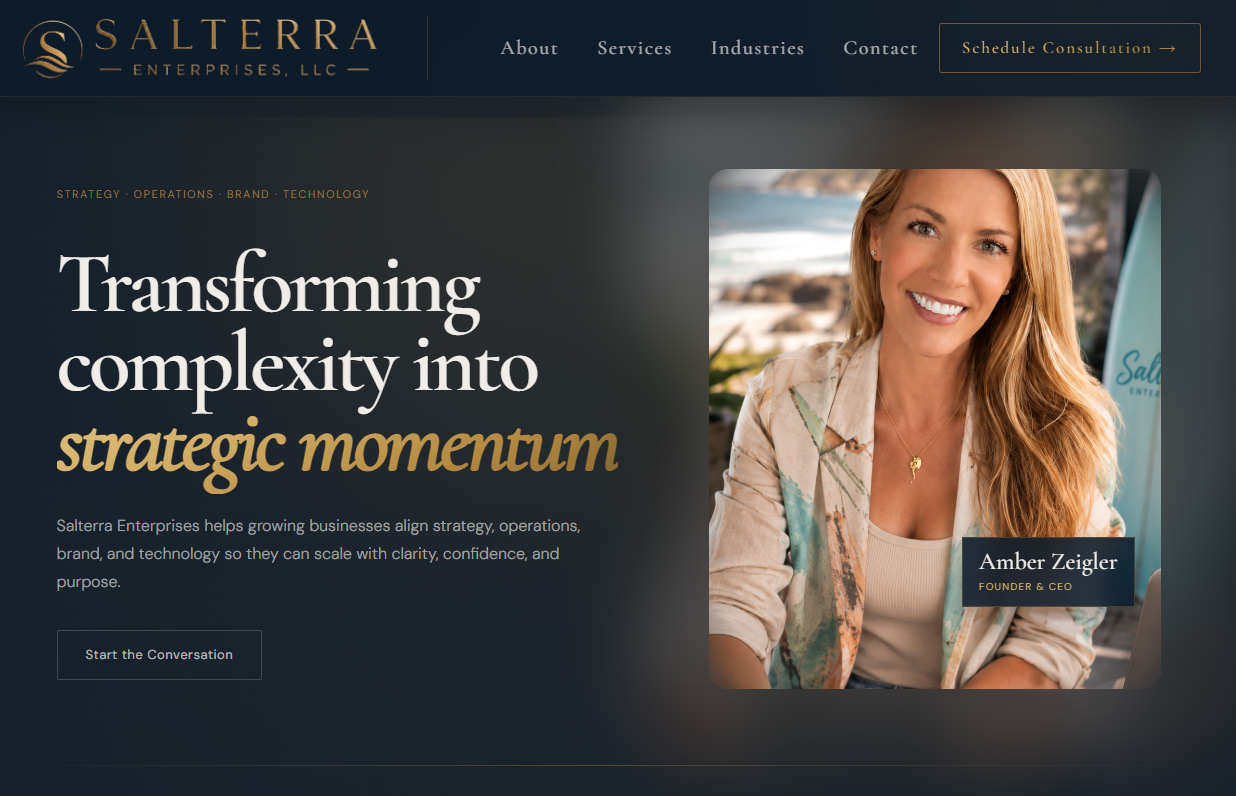
Homepage
Salterra Enterprises homepage screenshot
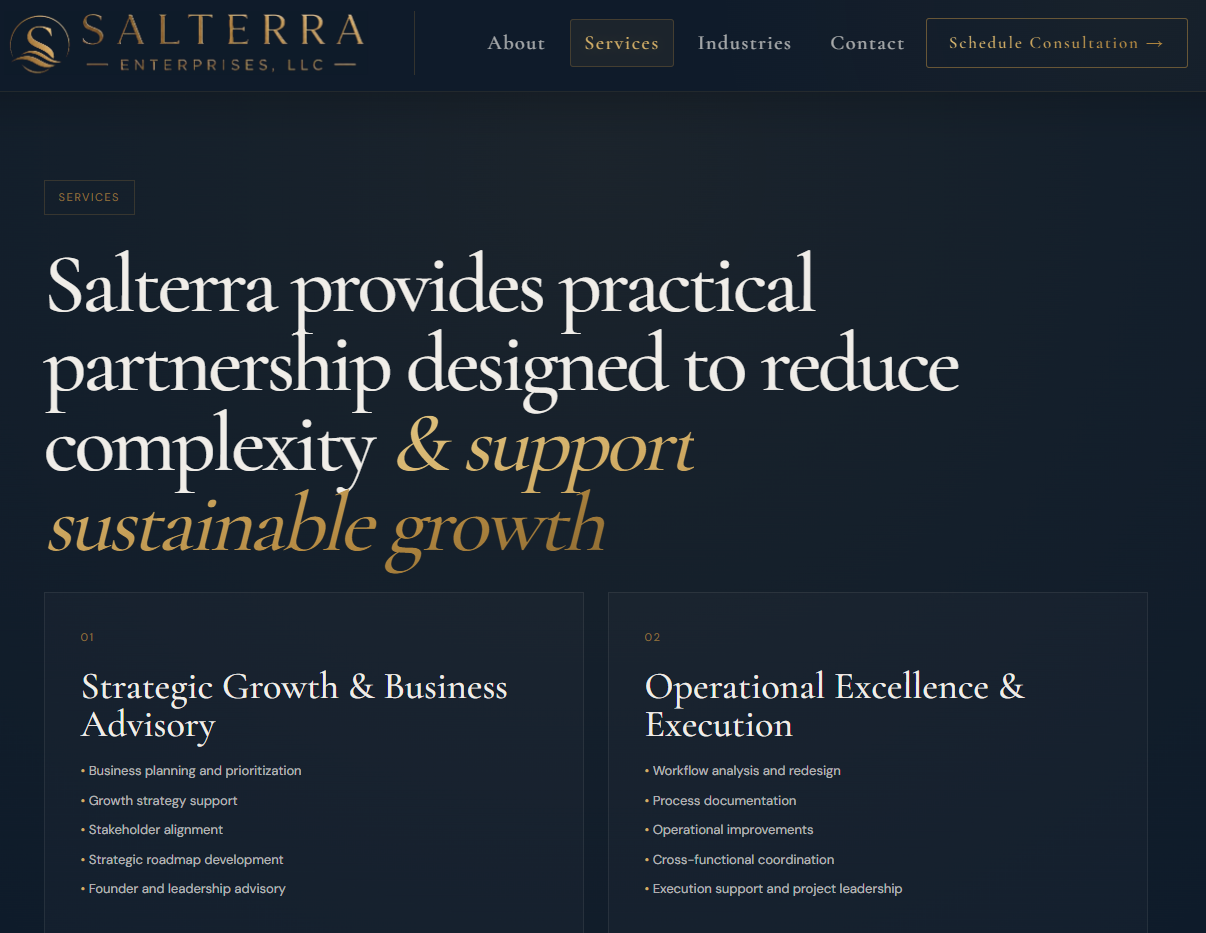
Services
Salterra Enterprises services screenshot
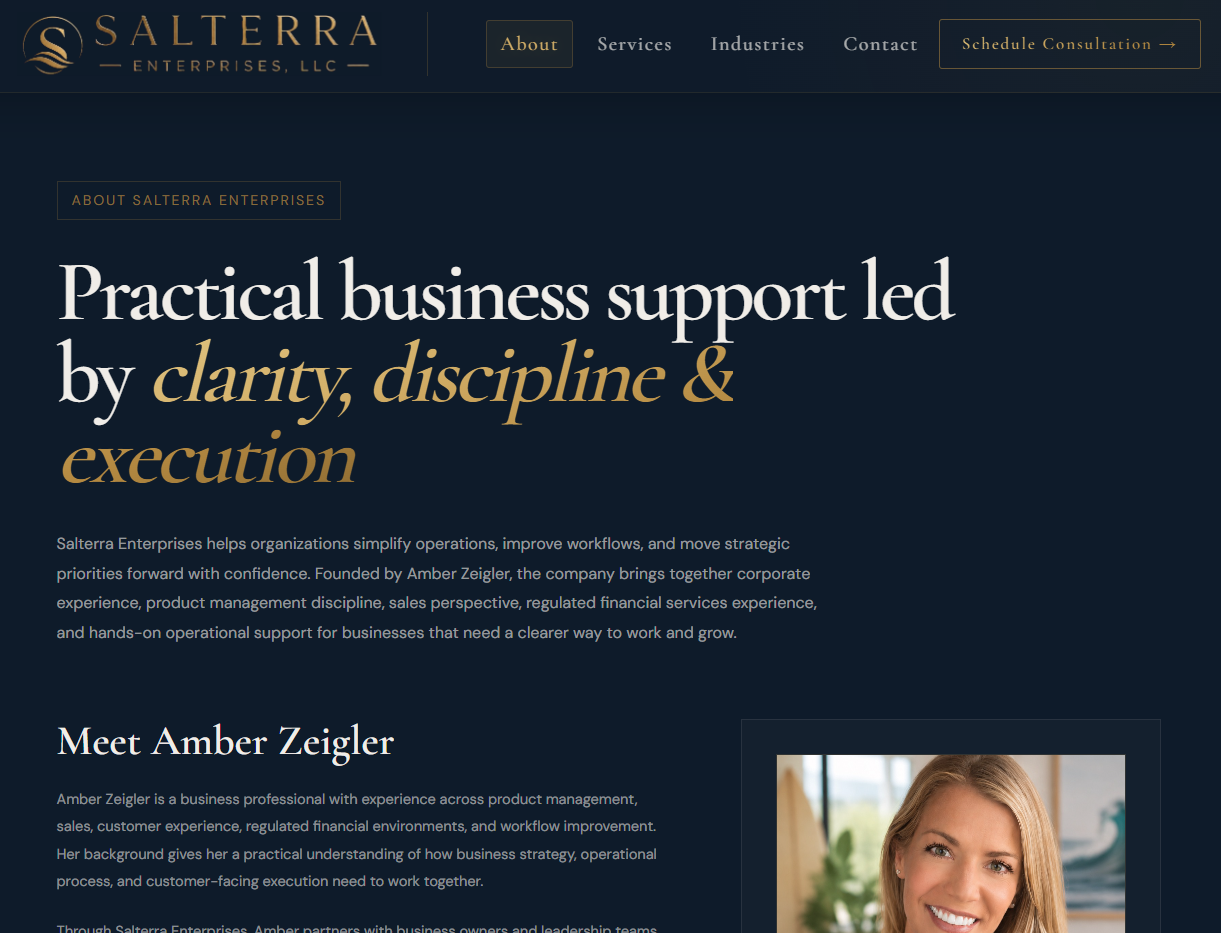
About
Salterra Enterprises about page screenshot

An experienced leader with no independent market presence

When the client came to me, they had no website, no defined service offerings, and no positioning statement. They had decades of results — but those results lived inside organizations that owned the credit. Stepping out independently meant starting from zero in terms of visible credibility.

The challenge wasn't capability. It was translation. How do you take twenty-plus years of enterprise operations expertise and turn it into something a client can read, understand, and confidently act on — without a resume, a job title, or an institutional brand behind it?

No digital presence

No website. No professional online identity. Invisible to anyone who searched for what they do.

No service structure

Years of expertise with no framework for how to scope, sell, or deliver it as a consulting engagement.

No positioning

Deep credibility with no language to express it — nothing that connected experience to client need.

Position first. Build second. Launch third.

Every decision on this engagement flowed from a single rule: don't touch the website until the positioning is right. A well-designed site built on weak positioning is just expensive noise. The work had to start with what the client actually does, for whom, and why it matters.

01
Discovery — extract the real positioning from the experienceExtended working sessions to pull out the actual expertise — not what the client thought they should say, but what they actually do and what makes it different. Most of the real positioning material was buried in stories about past work, not resume language.
02
Define the ideal client — who this is actually forIdentified the specific types of organizations and leaders most likely to benefit, most likely to engage, and most likely to value what this client brings. Specificity here is the difference between a general consulting brand and one that wins the right clients.
03
Structure the services — scope what gets deliveredMapped the client's experience into three clear service areas. Named them, scoped them, and framed each around client outcomes — not deliverables. This is what makes a consulting engagement something a client can evaluate before they say yes.
04
Build the website — architecture, copy, and CTA flowDesigned and built the website with a clear conversion path: problem to credibility to services to contact. Copy written to qualify the right clients, not just attract volume. Every element earned its place.
05
Launch — practical steps to go to market with confidenceDeveloped a practical launch plan: professional network outreach, LinkedIn positioning aligned to the brand, and initial conversation frameworks for turning existing relationships into early client conversations.

Credibility you can read, not just sense

The goal of the positioning work was to make the client's credibility legible. Enterprise operators who go independent often get trapped between two failure modes: being too generic ("strategic advisor") or too jargon-heavy ("driving operational excellence through stakeholder-aligned transformation"). Neither works.

The positioning for Salterra was built around operational specificity — what the client actually knows, at the level of detail that signals real expertise. Financial services operations has its own language, its own failure modes, and its own markers of quality. The positioning leaned into that specificity rather than softening it for a general audience.

  • Led with operational depth and institutional experience — not general advisory positioning
  • Named the specific types of organizations and situations the client works best with
  • Framed services around the client's problem, not the consultant's process
  • Kept language direct and concrete — no generic consultant copy
  • Built differentiation on depth and relevance, not claims of uniqueness
Positioning Output
Primary PositioningSenior financial services operations consulting — for organizations navigating complex operational transitions, compliance requirements, and performance gaps that need someone who has run these systems from the inside.
Ideal ClientRegional banks, insurance carriers, and financial operations teams that need senior-level operational expertise without a full-time executive hire. Decision-makers who value depth over generalist advisory.
Key DifferentiatorOperational depth from inside enterprise organizations — not strategic advisory positioning, not methodology-first consulting — direct pattern recognition from decades in the roles that built and ran these systems.

Simple. Credible. Converts.

A consulting website for an independent operator has one job: make the right client confident enough to reach out. It doesn't need to be complex. It needs to be clear.

The architecture was deliberately lean. One page for launch, structured around a single conversion path. The copy at every stage was written to either qualify the reader in or let them qualify themselves out — both outcomes are useful.

"The right clients read it and recognize themselves. The wrong ones move on. Both outcomes are correct."
Structure

Single-page architecture for launch speed. Clean narrative flow: context to credibility to services to contact. No clutter.

Copy approach

Every section written to move the right reader forward, not to impress a general audience. Qualifying copy beats volume copy.

CTA flow

Single primary CTA throughout — no decision paralysis. Contact path is visible and friction-free for a qualified reader.

Expertise structured for the client's decision

Independent consultants often struggle to name their services because their expertise is broad and contextual — it adapts to the situation. That's actually a strength. The job of service design is to create enough structure that a client can make a decision, while leaving enough room to actually solve the problem correctly.

Three service areas were designed and scoped for Salterra, each anchored to a specific type of engagement the client had strong track record in:

  • Operational assessment and design — reviewing and restructuring operational models for efficiency, resilience, and performance
  • Transformation leadership and advisory — providing senior-level operational leadership through periods of change
  • Implementation support — hands-on engagement to execute on operational improvements, not just recommend them
01

Operational Assessment & Design

Reviewing and restructuring operational models for efficiency, resilience, and measurable performance improvement.

02

Transformation Leadership

Senior-level operational leadership through periods of change — transition, integration, or significant process redesign.

03

Implementation Support

Hands-on engagement to execute on operational improvements — not just recommendations, but the follow-through to make them real.

Each service was scoped as a client outcome, not a deliverable list. This matters because clients hire for results, not for process. The scoping also includes enough specificity to enable confident sales conversations without boxing the client into a rigid methodology.

Practical. Not theoretical.

Launch strategy for an independent consulting brand is almost always the same answer: start with your network, not with strangers. Enterprise operators have spent years building relationships with potential clients, referral partners, and former colleagues who already know their work. The market already exists. The job is to activate it.

The launch approach for Salterra was structured around three phases:

1
Soft launch to professional networkPersonal outreach to former colleagues, clients, and contacts with a direct message about the new direction. Not a mass announcement — individual conversations with people positioned to refer or engage.
2
LinkedIn positioning aligned to the brandProfile updated to match the consulting brand positioning. Content strategy built around demonstrating specific operational expertise — not career updates or generic professional content.
3
Conversation frameworks for inbound and outreachSimple language templates for describing what you do, what a good engagement looks like, and how to start a conversation — for both inbound inquiries and proactive outreach.

A consulting brand that can hold up to enterprise scrutiny

Market-ready and launched

Salterra went from zero to market-ready in a single coordinated build. Not a soft launch without substance — a positioned, professional brand ready for enterprise conversations.

Positioning that qualifies clients

The website and positioning work together to filter for the right type of engagement. The right clients read it and recognize themselves. The wrong ones move on. Both outcomes are correct.

Confident sales conversations

Defined service areas and clear positioning gave the client a foundation for talking about their work with confidence — not selling, describing. The structure does the selling.

What this engagement reinforced

1

Experienced professionals often underestimate how much translation work going independent requires. Institutional credibility is real — but it doesn't travel. It has to be rebuilt in a form the independent market can read.

2

The website isn't the product. The positioning is. A clean, well-built website communicating weak positioning will underperform a simple site communicating strong positioning every time.

3

Service structure enables confident sales conversations. When a consultant can describe what they do in a scoped, outcome-oriented way, the client can say yes. Vague expertise is hard to buy.

4

Simplicity wins at launch. A one-page site with clear positioning and a clean conversion path outperforms a complex site with vague messaging. Add complexity after the first clients are in the door, not before.

5

Network is the first market. Enterprise operators go independent with a built-in advantage most founders don't have — a decade or more of professional relationships. The launch strategy should start there.

Building something similar?

If you're stepping out on your own and need to build the brand, the positioning, and the presence that matches what you actually do — let's talk.